
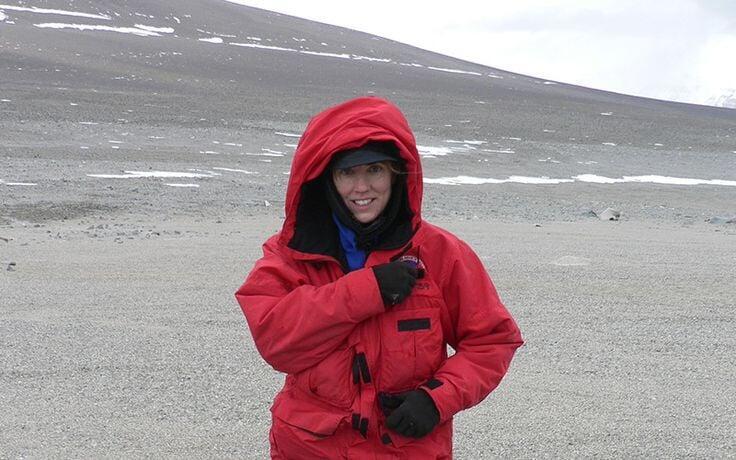
In the summer of 1999, a 22-year-old graduate student named Jane Willenbring stepped off a helicopter onto a ridge called Pivot Peak in Antarctica’s McMurdo Dry Valleys. Willenbring had come to read the rocks like pages in a diary, collecting samples that would help reveal how ancient glaciers had shaped the continent and what that history might mean for a warming planet.
What she found instead was a nightmare that would take nearly two decades to surface — and, when it finally did, would help force one of the most significant reckonings in modern science.The story of Jane Willenbring is not just about one woman’s ordeal in one of the most remote places on Earth. It is about the culture of silence that long protected powerful men in elite academic fields, the particular dangers of fieldwork in isolated environments, and the quiet courage it took to speak out at the precise moment when the world was finally ready to listen. Her experience unfolded in a slice of Antarctica known as the Ross Dependency, the vast region claimed by New Zealand that includes the Dry Valleys and has been the backdrop for decades of American scientific research.
Willenbring grew up in Mandan, North Dakota, the kind of small town where kids spend summers exploring river bluffs and wondering about the stories hidden in layers of soil and stone. She was the first in her family to pursue higher education with that kind of determination, earning a spot in the McNair Scholars program at North Dakota State University. By 1999 she had a bachelor’s degree in geosciences and soil science and had landed at Boston University for her master’s, drawn to the work of David Marchant, a charismatic young professor specializing in Antarctic glacial history.The field season seemed like a dream assignment. Four people — Willenbring, Marchant, his brother, and one other researcher — were dropped by helicopter into the wilderness near Pivot Peak. They lived in unheated tents, communicated with the outside world only by radio, and spent long days hiking, mapping, and chipping samples from ancient granite.
For a young scientist passionate about her work, it should have been exhilarating. Instead, according to detailed accounts Willenbring later provided in a Title IX complaint and interviews, Marchant turned the isolated camp into a place of systematic psychological and physical torment.He greeted her most mornings with the same mocking refrain: “Today I’m going to make you cry.” He repeatedly called her a slut and a whore. He pressured her to have sex with his brother while the four of them shared the cramped living quarters, making crude comments about their bodies. When she tried to relieve herself behind a rock in the vast, empty landscape, he threw stones at her.
During one episode of ice blindness, he deliberately blew volcanic ash shards into her eyes, knowing the pain would be excruciating. On a steep hike, he grabbed her backpack at the top of a slope, sending her tumbling down the rocks; he then twisted her arm and left her with bruises that lingered for days. Another time he pinned her wrists to the ground, spat in her face, and laughed.Terrified that reporting him would destroy her budding career, Willenbring began rationing her water intake to avoid having to urinate in front of the men.
The resulting bladder infection left blood in her urine, yet Marchant refused to let her return to McMurdo Station for medical help. She endured. She collected her data. She finished the season. And then she told almost no one what had happened.After earning her master’s in 2002, Willenbring made a deliberate choice to leave Boston University and Marchant’s orbit. She completed her Ph.D. at Dalhousie University in Nova Scotia under a supportive adviser. Postdoctoral work followed at the University of Minnesota and as an Alexander von Humboldt Fellow at the GFZ German Research Centre for Geosciences in Potsdam. By 2010 she was an assistant professor at the University of Pennsylvania.
In 2016 she moved to the Scripps Institution of Oceanography at the University of California, San Diego, where she eventually directed the Scripps Cosmogenic Isotope Laboratory.Her scientific contributions were substantial and widely respected. Using cosmogenic nuclides — rare isotopes such as beryllium-10 created when cosmic rays strike exposed rock — Willenbring developed precise ways to measure erosion rates and reconstruct the history of ice sheets. Her research has helped scientists understand how quickly glaciers retreated in the past and what that might mean for future sea-level rise. She has also studied nutrient cycles in Puerto Rico, tracing how dust from the Sahara Desert nourishes tropical forests thousands of miles away. She launched citizen-science initiatives, including “Soil Kitchen,” to make geomorphology accessible to the public. Honors followed: the Antarctica Service Medal, election as a fellow of the Geological Society of America, and the American Geophysical Union’s inaugural Marguerite T. Williams Award for outstanding contributions by a woman in Earth and planetary surface processes.On paper, she had made it. But the memories from Pivot Peak never fully faded.By 2016, Willenbring was tenured and raising a young daughter. One evening she brought the three-year-old to her lab at Scripps.
The little girl looked up at her mother in the white coat and safety goggles and said simply, “Mommy, you really are a scientist. I want to be a scientist just like you.” That innocent sentence, Willenbring later recalled, cracked something open inside her. She could no longer stay silent if it meant her daughter might one day face the same choice between enduring abuse and abandoning her dreams.In October 2016, she filed a formal Title IX complaint against Boston University and Marchant.
The complaint sat for nearly a year. Then, in October 2017 — just days after the Harvey Weinstein allegations ignited the global #MeToo movement—the story exploded into public view. A detailed investigation by Science magazine laid out Willenbring’s account alongside those of other women who said they had experienced similar abuse under Marchant. One former student described years of being called the c-word and the b-word, being told she was lazy and stupid, and facing threats to her funding and career. The pattern, the women said, was unmistakable.Boston University’s investigation ultimately led to Marchant’s departure from the institution. The glacier in Antarctica that had been named in his honor was quietly renamed.
The U.S. House Committee on Science, Space, and Technology opened its own inquiry. The National Science Foundation, which funds the vast majority of Antarctic research, changed its policies to require institutions to report findings of sexual harassment before awarding new grants. Professional societies began reexamining how they select fellows and award medals. Fieldwork safety protocols at remote sites were strengthened.Willenbring suddenly found herself at the center of a cultural shift. She appeared in the 2020 PBS “NOVA” documentary “Picture a Scientist,” sharing the screen with other women who had been pushed to the brink in male-dominated labs. She helped bring the “Growing Up in Science” lecture series to Scripps, creating space for senior researchers to speak honestly about the obstacles they had faced. She advocated publicly for better protections for graduate students and early-career scientists working in isolated field conditions.
The backlash was swift and ugly. She received death threats. Someone scrawled “Die cunt” on her office door and mailbox. Yet she continued her research, continued publishing, and continued mentoring the next generation of scientists.Today, Jane Willenbring is an associate professor of Earth and Planetary Sciences at Stanford University, where she still runs a laboratory focused on cosmogenic isotopes and landscape evolution. She still travels to field sites, though she is far more deliberate now about safety protocols and team dynamics. She still finds joy in the quiet moments when a rock sample begins to reveal its secrets about Earth’s past — and its possible futures.
Her story has become a touchstone in conversations about sexual misconduct in the sciences, particularly in disciplines that rely on remote fieldwork. Antarctic research, with its months-long seasons, tiny teams, and extreme isolation, had long operated with an unspoken understanding that complaints were difficult to investigate and even harder to prove. Willenbring’s willingness to speak out helped change that calculus.In interviews since the story broke, she has been careful not to define herself solely by the trauma. “I love the science,” she has said. “I love being in the field. I just wanted the environment to be one where everyone could do that safely.” She has emphasized that the goal was never to destroy careers but to ensure that young scientists — especially women and members of underrepresented groups — no longer have to choose between their safety and their ambitions.The broader impact is still unfolding.
Funding agencies now require more robust reporting. Universities have updated training and response procedures. Young researchers entering the field cite Willenbring’s case as a reason they feel slightly more empowered to speak up. And in the quiet laboratories and windswept field camps of the Ross Dependency and beyond, the culture is shifting, one conversation, one policy change, one brave complaint at a time.
Jane Willenbring never set out to become a symbol. She set out to study rocks in one of the most beautiful and brutal places on the planet. The fact that she had to survive her own mentor to do it — and then found the strength to tell the world what happened — has left a mark far more lasting than any glacier or granite ridge.The ice in the Dry Valleys continues its slow, ancient dance. The rocks still hold their secrets about past climates and future sea levels. But the story Willenbring told about what happened among those rocks has already begun to reshape the human landscape of science itself — making it, however incrementally, a place where the next generation of dreamers can focus on the work instead of simply trying to survive it.