
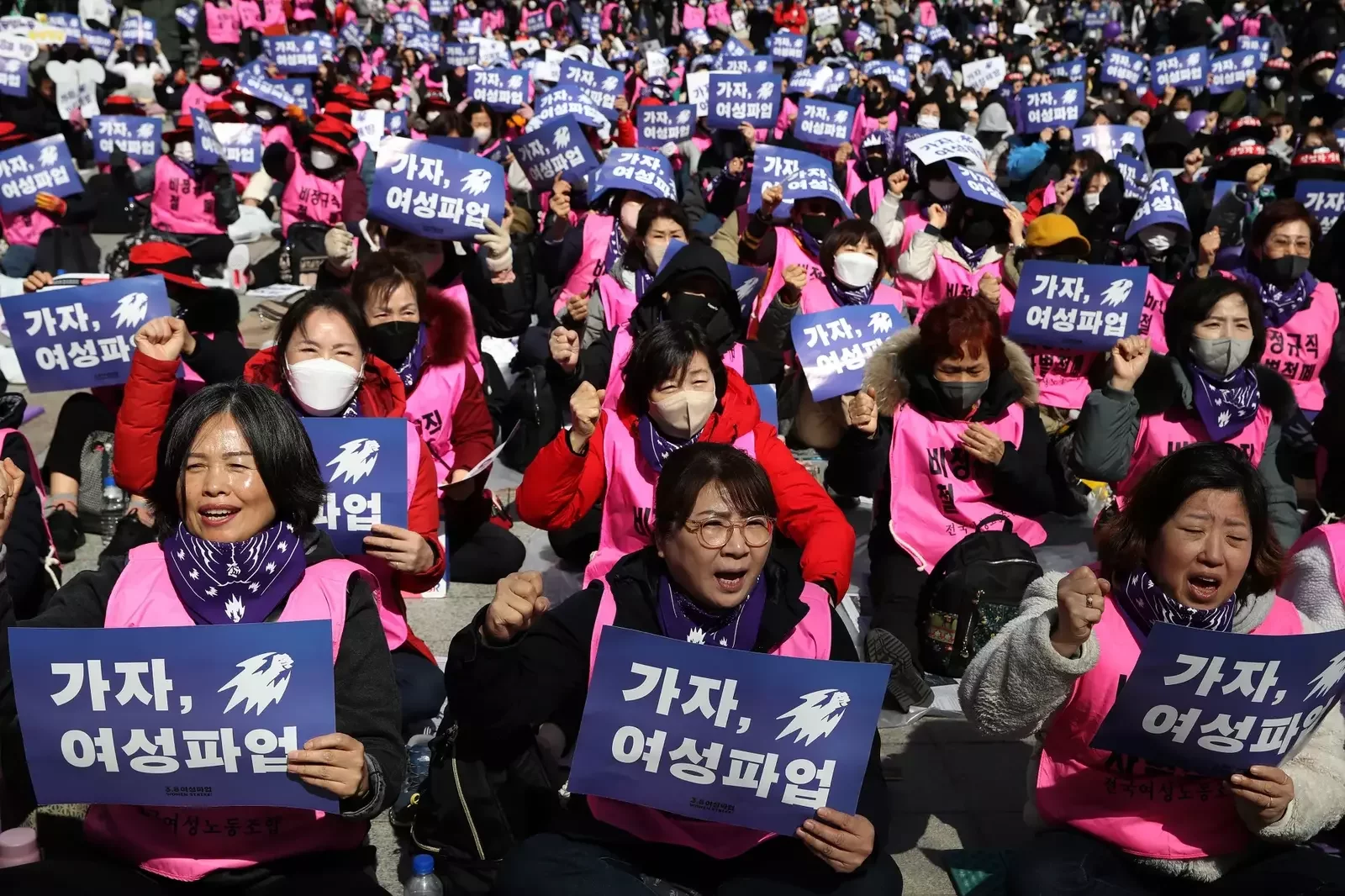
SEOUL—In the heart of one of Asia’s most modern cities, a quiet revolution began forming. South Korea's radical Feminists, through personal development and the prioritization of self, kicked off their fundamental redefining of what power looks like for a generation of South Korean womyn who were exasperated by the sexism, gynophobia, and misogyny in their culture and in their legislative climate.
The 4B Movement, characterized by the original principles of the womyn's liberation movement, introduces South Korea's womyn to a female separatist lifestyle. The 4 "Bs" represent four distinct areas of rejection regarding traditional expectations placed on female people in South Korea, and across the world. They all utilize the Korean prefix "bi-" (비), which translates to "no" or "not."
Bihon (비혼) - No (heterosexual) marriage.
Bichulsan (비출산) - No childbirth.
Biyeonae (비연애) - No (heterosexual) dating.
Bisekseu (비섹스) - No (heterosexual) sexual relationships.
“For too long, the roadmap for a woman’s happiness was dictated by others,” says Lee Na-young, a sociology professor at Chung-Ang University in Seoul. “4B is not simply about what these women are rejecting. It is profoundly about what they are choosing: autonomy, safety, economic freedom, and the space to exist without decorative labor.”
Coming off the heat of the #TimesUp and Me Too movement, the 4B movement—a pioneering wave of female solidarity—has emanated as an incredible expression of agency, autonomy, and self-determination in the face of institutional and systemic violence. This leaderless, decentralized phenomenon is the declaration by South Korea's womyn, of independence and a masterclass in prioritizing self-preservation and the prioritization of improving the material conditions of female people. This shift came during "feminist reboot" of the mid-2010s, a period of heightened awareness of sex-based violence catalyzed by 2016 Gangnam Station femicide and the ubiquitous crisis of digital sex crimes (molka), that have taken the nation by storm. For many of its participants, adopting the tenets of the 4B movement was not a sudden decision, it was a necessary, logical step toward guaranteeing their own security and well-being while navigating a society grappling with severe sex disparities.
The impact of this collective decision is reshaping the nation’s social and economic landscape. South Korea, like many nations, currently struggles with the world’s lowest birth rate, a statistic frequently cited as a "national crisis". However, 4B adherents don't view this as a problem caused by them, instead citing the country's refusal to confront patriarchal family structures and social trends that often force womyn and girls to sacrifice education, aspirations, and careers for child-rearing, lack of visibility, and domestic labor.
Digital sex crimes are destroying the lives and social mobility of South Korea's female population, and their government's underwhelming response has left the irreversibly disillusioned. The revelations of the Burning Sun scandal and the subsequent "Nth Room" Telegram chats unleashed a profound, collective trauma among the womyn and girls of South Korea. In light of the horrific scale and coordination of these crimes, the South Korean government’s response was agonizingly lackluster, characterized by apathy and institutional complicity by officials. While womyn were fighting for their lives and dignity, the justice system initially handed down shockingly lenient sentences to high-profile perpetrators.
The explicit police collusion uncovered during the Burning Sun investigation demonstrated that the state apparatus was actively protecting male abusers rather than the womyn they exploited, forcing victims to endure grueling legal battles that often re-traumatized them while their perpetrators faced minimal disruption to their lives.
That isn't even the worst of it. The South Korean government released a digital map color-coding regions by the number of women of "childbearing age". South Korea consistently has the largest gender pay gap among OECD countries. South Korea's men have repeatedly expressed various forms of hostility against their female counterparts, directly sending the message to the womyn and girls of South Korea that they are, for the most part, on their own.
“We are redefining what it means to live a full life,” says ‘Minji,’ a 28-year-old graphic designer in Seoul (who asked to use a pseudonym to protect her privacy.) “I am not ‘anti-man.’ I am ‘pro-me.’ I am investing my time, energy, and money into my friends, my skills, and my future, rather than a system that never prioritized me.”
Minji is not alone. The movement is powered by a robust digital ecosystem where womyn offer each other professional networking opportunities, financial advice for single living, and emotional support. This has fostered a thriving, gynocentric sub-economy, emphasizing solidarity over competition. While some critics might frame the 4B Movement as "extreme" or polarizing, its proponents counter that self-preservation is a necessity, especially for those in an environment that is hostile to them. They are creating new communities based on mutual respect and shared experience, rather than traditional hierarchy.
Ultimately, the 4B movement represents a powerful statement of resilience, self-esteem, and sex-class consciousness. By withdrawing their participation from relationships that have historically disenfranchised them, South Korean women are actively authoring their own futures, redefining success, and showing the world that the most impactful revolution can sometimes begin with a simple, personal "no."